The Gaze You Can’t Return
“It’s surveillance.” With Foucault and the panopticon: the three properties of a surveillance device — which ones a registry can reverse, and which it never can.
The Objections That Hold Up (1/2) — Michel Foucault, the panopticon, and the question of who is watching.
“It’s surveillance. You want my data.”
This one comes earlier than the others. Often within the first five minutes, sometimes before we’ve even finished explaining. It’s almost never hostile. It’s clear-eyed.
And it deserves better than a denial. “No, it’s not surveillance” convinces no one, for a simple reason: it’s false. A registry is a visibility device. Starting by denying that is starting with a lie, and no one in a farmhouse kitchen is fooled.
Better to take the objection seriously. Which means going to see what the word actually covers.
The Panopticon, Properly Understood
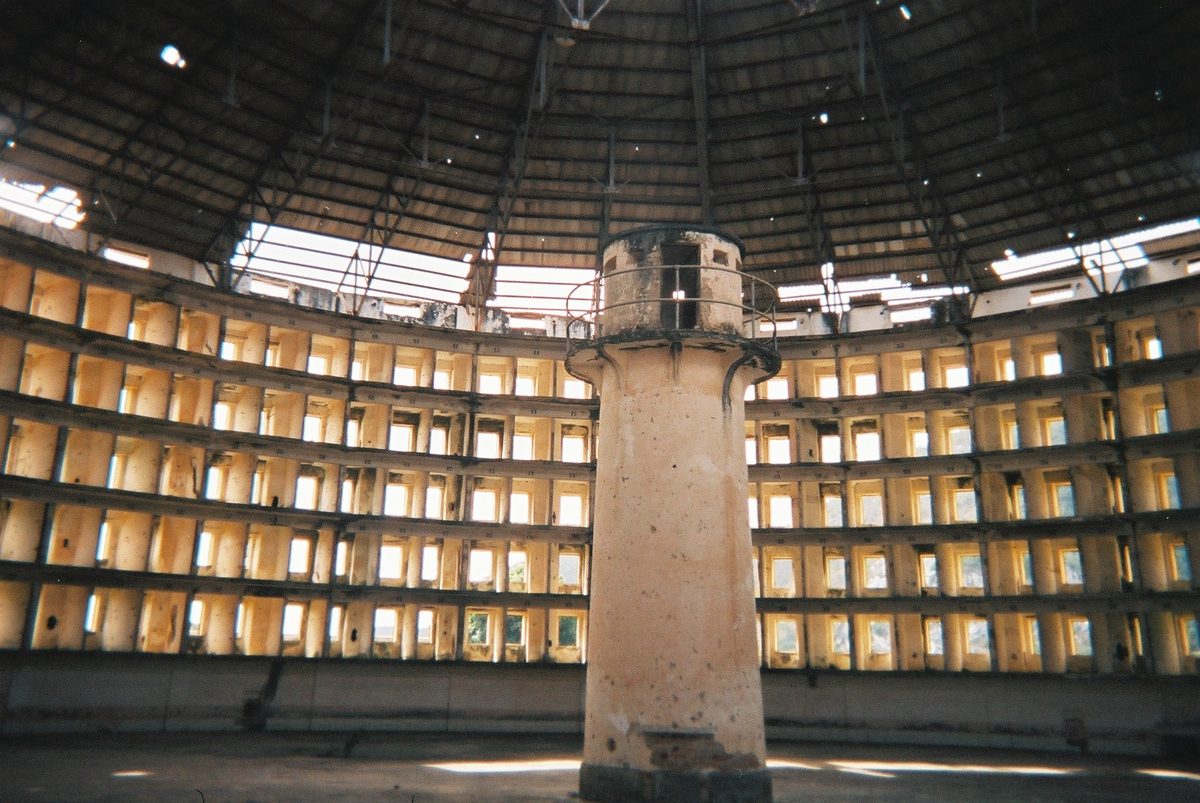
The image comes from Bentham, and Foucault made it famous in Discipline and Punish. A central tower; around it, cells arranged in a ring, lit from behind. The guard sees every inmate. No inmate sees the guard. “Visibility is a trap,” Foucault writes.
What gives the device its power isn’t the surveillance itself. There are three properties to distinguish, because everything that follows depends on them.
Asymmetry, first. The gaze only travels in one direction. The device splits the pair of seeing and being seen: you are seen without ever seeing.
Unverifiability, next, and this is the real find. Power must be, Foucault says, visible and unverifiable. Visible: the inmate has the tower in view at all times. Unverifiable: at no point does he know whether anyone is in it. So he has to behave as if he were being watched, all the time. Hence the effect Foucault describes as the true object of the device — the watched ends up becoming the principle of his own subjection. The guard can step away; the machine keeps running without him.
Isolation, finally, the one almost everyone forgets. The cells are separated by lateral walls. Inmates don’t see each other, don’t speak to each other, don’t organize. The panopticon doesn’t just surveil: it dissolves the crowd into a collection of separated individuals. It prevents coalition as much as it produces visibility.
Foucault adds a fourth element, less spectacular and more important for us: writing. Discipline produces files. It describes, classifies, compares, constitutes each person as a case — describable, measurable, placeable against an average. That is the writing the other great objection targets, the one about the record sheet. I’ll come back to it in a second piece.
Ten Gazes, No Return
There’s the lens. Let’s apply it to the situation of a French producer today — before any intervention on our part.
He files his acreage and crops electronically, and is subject to inspection on paper and on the ground. If he sells to a retail chain, he signs a set of specs he didn’t write. If he’s certified — organic, a label, IFS, BRC, GlobalGAP — he’s audited against a standard he didn’t draft, on dates he doesn’t choose, by a body he himself pays. If he processes, he keeps health records that can be used against him. And the list goes on.
About ten gazes, none of whose criteria, calendar, or consequences he sets.
Now look the other way. What does he know of what happens to his product once the truck has left? At what price it’s resold, to whom, at what margin? On what basis a buying group decided this year to delist him? By what calculation his price was set, and by whom?
Nothing. He learns the outcome, never the rule.
That is Bentham’s asymmetry, term for term. And it’s also its unverifiability: he knows he’s being watched, he never knows when or how the decision is made, so he adjusts out of caution. He behaves as if he were watched at all times. He has become the principle of his own subjection, and no one needed to build a tower.
I’m not writing this to point fingers. Most of these gazes have good reasons to exist: health safety isn’t a whim, control of public subsidies isn’t either, and a set of specs isn’t in itself a bullying tool. I’m only saying that the question “do we need one more gaze?” is the wrong question. There are already ten. The only question worth asking bears on the properties of the device: which way it looks, and what the one being watched can do with that.
Three Properties, Three Reversals
Let’s take them in order, because none reverses the same way.
First, unverifiability. Bentham’s inmate doesn’t know if he’s being watched, and he can’t read his own file. That’s what makes the device so economical: it doesn’t even need to be running to produce its effects.
A registry can reverse this term for term, and that’s the easy part. The rules are written and public: what is recorded, how, for how long, with what consequences. The record itself is fully accessible to the person it describes — no part of the file is closed to him, if only because he is its source.
But that isn’t enough, and this is where precision matters.
Next, asymmetry. Knowing what’s written about you isn’t knowing who read it. Bentham’s real find wasn’t about the file: it was about the uncertainty around the gaze itself. A producer who can view his entire own record, but doesn’t know who consults it, is still exactly in the inmate’s position.
The answer fits in one line, and it’s almost trivial to build: a consultation log. Let the producer see who looked at his data, when, and on what basis. Let a buying group that combs through his history leave a trace he himself can read. Let the gaze itself be recorded in turn.
A panopticon where the inmate sees the guard watching him is no longer a panopticon. It’s a room where two people face each other.
I wrote this here before it was decided at our end, because an intention stated before witnesses commits more than an internal memo. We have since built it: the producer has a screen showing who consulted their data, when, and on what basis. With one clause I consider the most important part — the log itself lists what it does not yet cover, because a partial registry presented as complete would be worse than no registry at all.
Finally, isolation. The panopticon’s lateral walls don’t serve to improve surveillance; they serve to keep the watched from talking to each other. This may be the most political of the three properties, and the most discreet.
A device that produces visibility but lets its members deliberate together is no longer the same device. That’s what’s at stake in producers having seats — criteria being discussed by a joint body rather than endured, and those being measured able, together, to change the measure. This isn’t democratic window-dressing added to a surveillance tool. It’s the panopticon’s third property being removed.
What Doesn’t Reverse
Three properties reversed isn’t a rebuttal. Foucault doesn’t only speak of the panopticon; he speaks of normalizing power, and that one doesn’t reverse.
The norm, first, and its outside. Our tagline says: the registry of those who prove. That sentence has to be read all the way through. A registry of those who prove constitutes, in the same movement, the category of those who don’t. That isn’t a perverse side effect a better design would fix someday: it’s what a norm does. It divides.
There are two things we can do, and we will do them. Never make non-registration grounds for a penalty. And keep reminding people, as often as it takes, that the target has always been the unverifiable — never the foreigner, never the small player, never the one with no time to spare. What we can’t do is stop a buyer from reading an absence as a signal. No one can. That’s a real cost of what we’re building, and presenting it any other way would be dishonest.
Internalization, next, which settles even less. A visibility device changes the one it makes visible — even chosen, even paid, even governed by him. The day a producer decides on a gesture by thinking first of what the registry will keep of it, something will have shifted, and not for the better. No governing body protects against that. No consultation log either. It’s the deepest effect Foucault describes, and I have nothing solid to set against it.
Only one thing can soften it: that the registry assigns no score. That it attests to facts without judging the manner. But that’s the subject of the second piece, and it deserves its own.
Voluntariness, last — which I’m keeping for the end because it proves less than one thinks. No one enters here under compulsion. No legal obligation refers back to us, the producer pays nothing, and he can leave whenever he wants without losing anything.
That settles one question, and only one: legitimacy. No one will be able to say a gaze was imposed on them — which is exactly what Bentham’s inmate cannot say, and that isn’t nothing. But if we think that’s enough, we’ve only answered half the objection. Consent says who has the right to look. It says nothing about what the gaze sees, or what it will never see.
What Foucault Asks
He never demanded that the gaze be abolished; he considered that idea naive. He asked that the device itself be examined: where the gaze comes from, who can return it, what it produces in the one who receives it, and who decides what it looks for. It’s a demand, not a condemnation. And it’s the only one we can reasonably be held to.
So when someone tells me it’s surveillance, I no longer answer that it isn’t. I answer: let’s look at which way it points. About ten gazes already fall on your farm without you being able to hold a single one accountable. We’re proposing one more — the only one whose exerciser you’ll see, whose rules you’ll be able to discuss with those enduring them alongside you, and which will pay you instead of billing you.
That’s not nothing. It isn’t innocence either.
There remains the other objection, the one that starts with “you can’t put everything on a form.” It’s harder, and I haven’t finished answering it. That’s the next piece.
Reference
Michel Foucault, Surveiller et punir. Naissance de la prison [Discipline and Punish: The Birth of the Prison], Gallimard, 1975 — especially the chapter “Panopticism.”
Ce que ça change pour vous
Le même raisonnement ne se joue pas au même endroit selon votre place dans la chaîne.
Vous êtes producteur
About ten different gazes already fall on your farm — the CAP, buyer specs, certifications, health registers — and you can’t hold a single one accountable. The question isn’t “one more gaze?” but which way it looks.
VeraTrace pour les producteurs →Vous êtes collectivité ou acheteur public
A visibility device is judged on three properties: which way the gaze runs, what the watched party can verify, and whether it can deliberate with others. Three criteria useful well beyond us, for any tool you fund.
VeraTrace pour les territoires →Vous êtes distributeur ou centrale d'achat
The producer learns the outcome of your decisions, never the rule behind them. The consultation log makes your gaze visible to the one it watches: it is live, and it lists what it does not yet cover.
VeraTrace pour la distribution →Vous accompagnez des producteurs
You know the audit fatigue of those you support. The “it’s surveillance” objection isn’t bad faith: it’s accurate, and it deserves an answer about the device itself, not a denial.
VeraTrace pour les prescripteurs →