Who Keeps the Register?
Power does not reside in knowledge but in the place where inscriptions converge. The real question is not “do we need a register”, but who audits it.
A harvest exists twice. Once in the field: tons, a quality, a fatigue. Once in the registers: lines, codes, reference prices. The first version feeds. The second decides — the price paid, compliance, who gets to negotiate what with whom.
These two existences do not occupy the same place. And the question that should open every debate about food is rarely asked: what happens when the one who produces the first version has no access to the second?
To see clearly, a detour. Far from the fields: the Pacific, 1787.
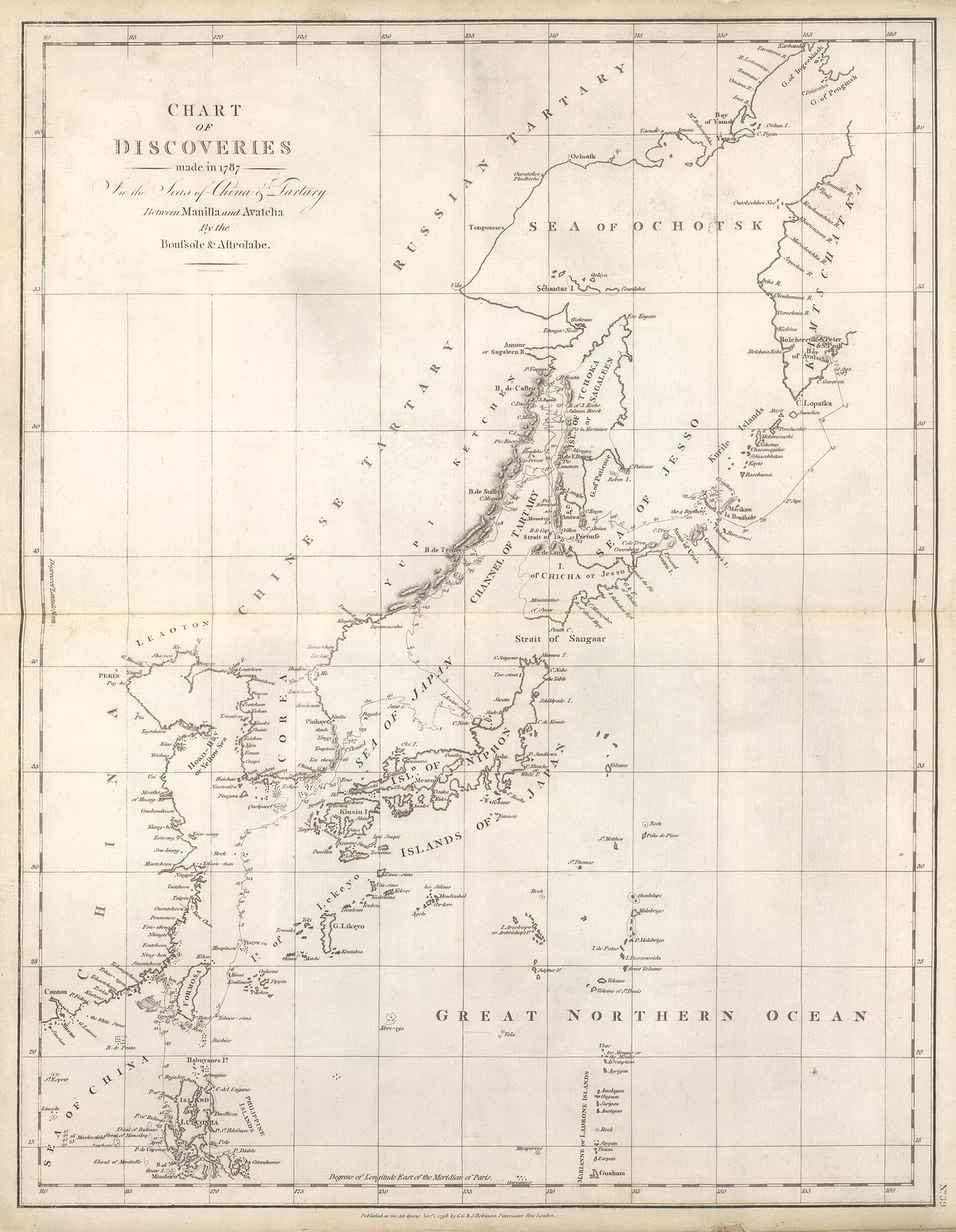
Lapérouse is sailing along the coast of Sakhalin, north of Japan. A question has obsessed European cartographers for a century: is Sakhalin an island, or a peninsula attached to the continent? He comes ashore. On the beach, an elderly fisherman understands the question and draws the answer in the sand: the coastline, the strait, the scale of the distances. The tide rises. The map is erased. A younger man redraws it — this time in the expedition’s notebook.
The notebook, unlike the sand, does not erase. It sails on board, crosses oceans, arrives in Versailles, is added to other surveys, is compared, corrected, printed. The following year, a European navigator who has never seen these waters knows more about them than the fisherman who spent his life on them.
Not because he is more learned. The fisherman knew everything — he was, in fact, the source. But his knowledge lived in the sand: exact, complete, and lost with every tide. What made the difference comes down to two properties: the notebook’s inscription was mobile — it travels — and immutable — it arrives intact. And above all, it had a destination: a place that accumulates. Sand disperses; Versailles accumulates.
This is where power resides.
Not in knowledge: the fisherman had more of it than anyone. In the place where inscriptions converge. Call it a center of calculation: the place where maps, surveys, and delivery notes flow in, and where one can therefore calculate what no isolated contributor could ever calculate — compare, aggregate, rank, forecast.
Whoever keeps the register sees the entire chain. Each contributor sees only their own link. This asymmetry is not an injustice bolted onto the structure; it is the structure. Whenever someone negotiates knowing less than the party across the table, look for the register: it is never far away.
Back to the fields. The fisherman of Sakhalin still works there.
Every delivery made by a producer generates its own inscriptions: a delivery note, an EDI message, a line in a supplier portal, a quality record at reception. All of them are mobile, all of them are immutable, and all of them flow in the same direction — downstream. None flow back. The producer signs the map, the tide passes, and he goes back to drawing the next one.
At the end of the chain, a purchasing group is a center of calculation in the fullest sense. It can compare all of its producers against one another: yields, prices granted, defects, lead times. No producer can compare purchasing groups against one another. Most cannot even retrieve their own delivery data from three years ago — it exists, but in someone else’s register.
It must be said plainly: no one is cheating. The purchasing group does exactly what Versailles did, what every center of calculation has always done — accumulate what converges toward it and draw its calculating power from that accumulation. Everyone, all along the chain, rationally optimizes the position the structure gives them. The problem is not moral. It is topological: every inscription goes to the same place, and those who produce it have no access to it.
Why does no one seem to mind?
Because a register that works becomes invisible. No one asks who keeps the books as long as the books balance — just as no one asks how an engine works as long as the car keeps running. It takes a breakdown to pry the box open: a food-safety scandal, a batch recall, a dispute over a price. Then, for a few weeks, everyone discovers the question. Then the box closes again.
But there is a trap here, and it deserves to be faced rather than dodged: replacing one center of calculation with another is not progress. Whoever shows up promising “a new register, better, fairer” — a startup, a cooperative, a government agency, whatever the costume — is applying for the role of Versailles. The inscriptions would simply converge elsewhere, and the asymmetry would change beneficiaries.
So the right question is not “do we need a register?” One already exists — that is precisely the starting point. The right question is: who can audit the keeper of the register?
What would a register that answers this question look like?
Three things. Open formats, first: so that anyone can read the inscriptions without asking permission, using tools that belong to no one. Reversibility, next — the same requirement as for a proof, applied this time to the register itself: every contributor must be able to redo the calculations that concern them, verify that their line says what they actually delivered, retrieve their data from three years ago as easily as from yesterday. A register that cannot be recalculated by its contributors is a black box with better manners.
And governance, finally: that those who produce the inscriptions have a seat where the inscriptions are assembled. The fisherman of Sakhalin is not only entitled to a copy of his map. He is entitled to a place in the room where the maps are cross-checked — because without him, there is no map at all.
Sakhalin was an island. Lapérouse never knew it: his expedition was lost with all hands before it could return, somewhere in the Pacific. Only his notebooks, shipped onward from port to port, made it back to Versailles. The inscriptions outlived the man who carried them.
That is the whole matter, summed up by a shipwreck: registers outlast us. All the more reason to choose, while there is still time, who keeps them.
—
The story of Lapérouse at Sakhalin is borrowed from Bruno Latour (Science in Action, 1987), who showed better than anyone that knowledge weighs nothing until it accumulates somewhere — and that the place where it accumulates is always, also, a place that must be governed.
What this means for you
The same reasoning doesn't play out the same way depending on where you sit in the chain.
You're a producer
Your data doesn’t first raise a question of confidentiality but of place: what matters is where it converges, and who can audit that point of convergence.
VeraTrace for producers →You're a public authority or public buyer
A food policy only applies to what it can see. The lever isn’t the standard — it’s the register the standard relies on.
VeraTrace for local authorities →You're a wholesaler or trader
Keeping the register of a supply chain is a position, not a technical function. Better to know which one you occupy, and on what basis.
VeraTrace for wholesalers →