The Batch Number Is a Pineal Gland
Descartes separated thought and extension, then glued them back together with the pineal gland. Declarative traceability does the same thing with the batch number.
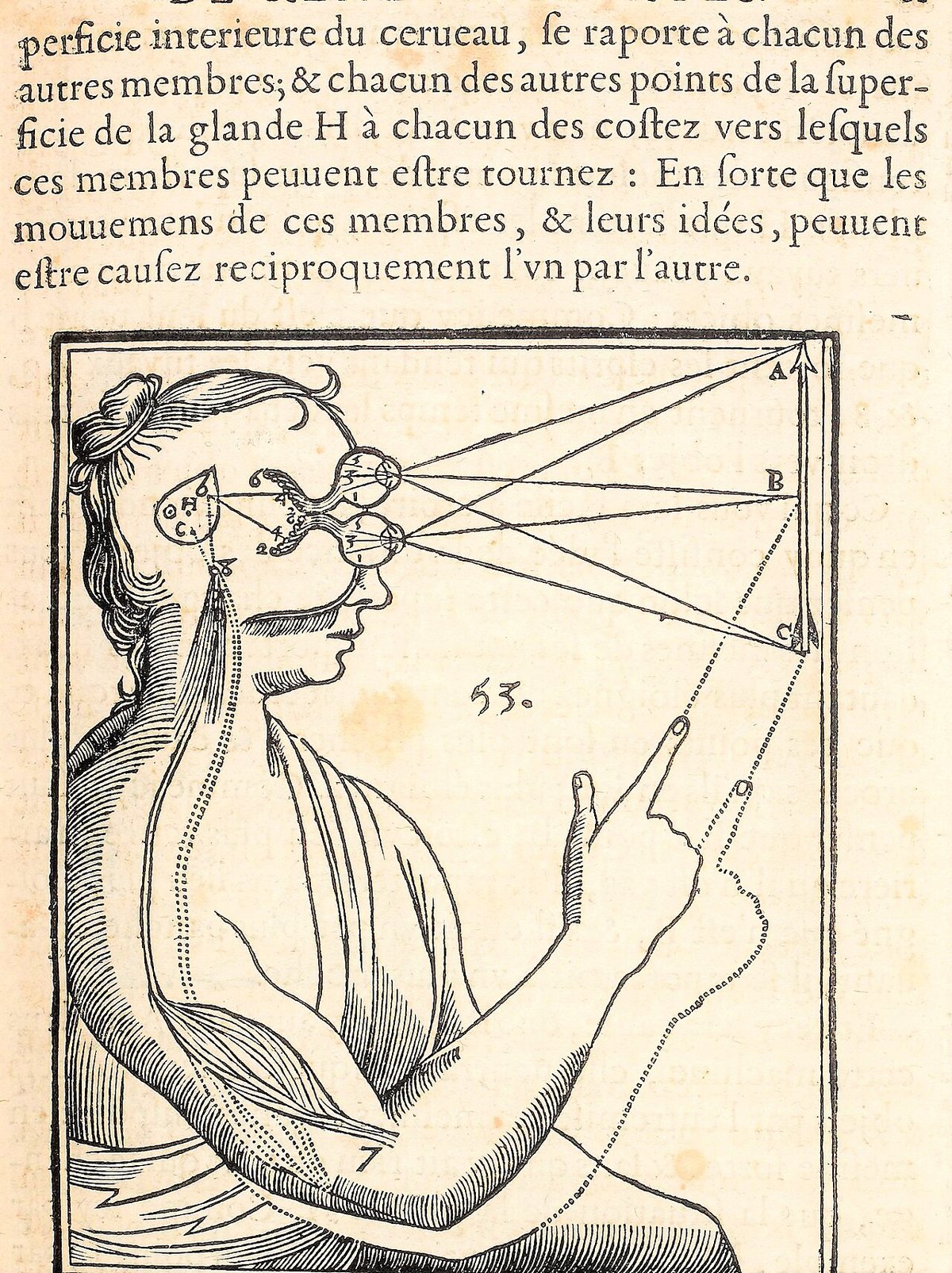
Descartes, Spinoza, and why declarative traceability could never hold.
Descartes spent part of his life cleanly separating two things, and the rest of it trying to glue them back together.
On one side, extension: bodies, matter, what occupies space and obeys mechanics. On the other, thought: ideas, the soul, what weighs nothing and has no location. Two entirely distinct substances — and it was this separation that allowed modern physics to be born, because bodies could finally be treated as machines without looking for intentions in them.
One problem remained. We are both at once. I want to raise my arm, my arm rises. Where, exactly, does thought touch extension?
Descartes answered: in the pineal gland. A small formation at the centre of the brain, chosen because it was unpaired — since other organs come in twos, a single point was needed for a single subject. A flimsy anatomical reason, for a crushing metaphysical burden: the whole edifice rested on this point of contact.
Spinoza was not kind about it. In the preface to Book V of the Ethics, he examines the hypothesis and says, in substance, that he would not have believed something so obscure possible from the pen of so great a man. Respect and refusal in the same sentence. It is the tone I would like to keep here, because what I am about to discuss is no foolishness. For a long time, it was the only solution available.
The food chain is Cartesian
Look at how regulatory traceability is built, and you will see two substances.
There is the world of things: the plot of land, the vat, the truck, the loading dock, the fruit loaded at six in the morning. It has weight, it spoils, it moves.
And there is the world of records: the register, the certificate, the form, the information system, the checked box. It weighs nothing, has no location, duplicates at no cost.
Two complete orders, each coherent within itself, with no inherent relation between them. The record knows nothing of the truck: it knows what it was told about the truck. This is exactly Descartes’s situation — two substances that must then be made to correspond, with nothing in their nature predisposing them to it.
In the previous piece, I wrote that compliance had become a rite that substituted itself for the thing. That was true, and it was still generous: a corrupted rite can be reformed. What I am describing here is harsher. This is not a record that has stopped coinciding with the act. It is a record that cannot, by construction. More rigour will not fix this.
The point of contact
So Descartes’s question returns, intact: where do the two substances touch?
The food chain has its answer, and it holds in a string of characters printed on a package. The batch number.
It is there, and only there, that the world of things and the world of records meet. Everything else depends on it: the health recall, the retracing of origin, legal liability. A tiny, conventional point, carrying the entire edifice. A pineal gland.
It is even worse off. The pineal gland at least had the advantage of existing: it was an organ, it could be shown. A batch is not a thing. It is a documentary unit projected onto a flow that contains none. Where does it begin, where does it end? When two vats are mixed, when a pallet is split, the boundary of the batch is a management decision, not a physical fact. Descartes at least sought his point of contact in the real. We invented ours.
And it has a second weakness, one that interests me more. A batch is a generality. It designates a class — every jar filled that morning — never this particular object. Those who have read the second piece in this series will recognise the ceiling: one does not trace back from a batch to this particular fruit, one traces back to a class and stops there. The Cartesian point of articulation is also what forbids the third kind of knowledge. The singular is out of reach, not through negligence, but because the articulation itself is built to disregard it.
The guarantor
There is a second consequence of dualism, and it explains an entire industry.
If the idea and the thing are two foreign substances, nothing in the idea can attest that it corresponds to the thing. Descartes saw this, and needed a third party to guarantee the correspondence: a truthful God, who does not deceive me. His entire epistemology hangs from this guarantee.
Where does this seat sit, in the food chain? I long believed it was held by the certificate. That is inaccurate, and the second piece in this series explained why: a certificate is a sign. It has the strength and the weakness of a sign, like the label and the origin claim — it guarantees nothing, it announces.
The guarantor is the audit. Descartes does not invoke God for every idea: God is the standing guarantee that makes correspondence believable in general. The audit occupies exactly that seat. Someone went to look, once, and twelve months of continuous flow rest on that single visit. It is not one control among others. It is what makes everything else believable.
And it must be said plainly: no one dug this seat out of appetite. Dualism made it necessary. The moment the record and the act are posited as two separate worlds, someone must go and check, from time to time, that one resembles the other. Doing this seriously is a difficult profession, practised by people who know what they are doing, and of whom the impossible is asked: to hold, on one annual visit, what plays out every single day.
In the first piece of this series, I quoted Spinoza’s formula: verum index sui et falsi, the true is the index of itself and of the false. I did not say then what it was directed against. It is directed against the necessity of the guarantor — not against those who take on that role. A true idea needs no external authority to be true; it carries its certainty within itself. The whole question is whether a proof can do the same.
And if it can, the profession does not disappear: it sheds its least interesting part. Checking that a register is properly kept — anyone can do that. Appraising a setup, arbitrating a borderline case, seeing what no record will ever say — that requires judgment, and judgment cannot be automated. I have no wish for a world without trusted third parties. I wish only that we stop asking them to stand in for God.
The idea of the body
Spinoza did not solve Descartes’s problem. He dissolved it, by refusing the separation.
There are not two substances. There is a single reality, expressed under several attributes. The order and connection of ideas, he writes, is the same as the order and connection of things. And he adds a sentence that changes everything: the object of the idea constituting the human mind is the body. The mind is not above the body, does not command it, is not added to it. It is its idea. The same thing, two expressions.
Transpose this, and you have what I am trying to build.
A traceability proof is not an intelligence brought to a gesture that would otherwise lack it. It is the idea of that gesture. The same reality, expressed differently — not a representation produced after the fact, in another world, that would then need to be made to correspond to the first.
This has a very concrete consequence, and it is why I favour the sensor over the form. A declaration written after the act, separately from it, is structurally incapable of being its idea. It is an idea about the thing, not the idea of the thing — and that is precisely why it needs a point of contact and a guarantor. A record produced at the very instant of the gesture, by the gesture, needs neither. There is no distance to cross, because there were never two substances.
I believe this is what a Spinozist transparency is. Not a faithful image of reality, validated from above. Reality itself, expressed under another attribute, at the moment it occurs. The guarantee stops being above the chain. It is inside it, distributed, with no overseer.
Proofs that compose
There is a consequence of parallelism I did not see right away, and it may be the most useful of all.
If each proof is the idea of an act, then acts that combine produce proofs that combine. Not through an effort of integration, not because we finally managed to make systems talk to one another — but because they follow the same order as the things of which they are the ideas. The link does not need to be built. It is already in the real.
Spinoza describes at length, in Book II, how bodies combine: when several bodies agree with one another, they form a third, more powerful than any of them separately, which can be treated as an individual. A food chain is exactly that. Not a sequence of actors juxtaposed, later connected by an information system. A composite body, that has long been acting as one.
The farming world knows this better than anyone. Equipment lent between neighbours, a combine harvester owned by twelve farms, mutual aid with eighty years of structures behind it: these are composite bodies that work, and that no software ever invented. What they lack is not coordination. It is that nothing records what they do — so nothing can recognise it, or pay for it.
This is why I am wary of how this kind of project tends to be described, including when I am the one speaking. We say we are building a network. That is false, and weaker than what is actually happening. The network is already there. What is missing is its idea.
What proof does not do
One limit must be stated honestly, and it is found in Spinoza himself: the attributes do not act on one another. The idea does not push the body. A proof, by itself, changes nothing in the chain — it does not lower a price, does not restore a margin, does not constrain anyone.
This is not an admission of weakness. It is the exact place of what I do. I wrote in the fourth piece that proof does not reassure the eater but makes them active: that is where everything happens. Proof does not act on the chain, it makes someone capable of judging. The economic effect passes through a judgment made possible, never through a constraint imposed from above.
A word, to close, on those who built the declarative system — because I do not want this piece to become a pamphlet, and least of all a national one.
Descartes did not separate the substances out of carelessness: it was the price of a physics. No one invented declarative traceability out of laziness. As long as no one knew how to capture an act at the moment it occurred, after-the-fact declaration was the only conceivable option, and the batch number the only possible point of contact. What has changed is not the virtue of the actors. It is what has become technically feasible.
What remains is to draw the consequences. A winegrower’s hand knows the harvest is ready. This knowledge is complete, adequate, it lacks nothing — except a form in which to circulate. It is not a mind that needs to be added to this gesture. It is its idea that must stop being lost.
And what holds for a single gesture holds for what they form together.
We are not building a network. We are making visible the one that is already there.
What this means for you
The same reasoning doesn't play out the same way depending on where you sit in the chain.
You process food, you're a brand
The batch number is the point of contact between two worlds that don’t talk to each other. It proves nothing by itself: it promises that a correspondence exists somewhere.
VeraTrace for processors →You're a wholesaler or trader
You receive batches whose upstream correspondence you cannot verify, and you reship them under your own. Every link adds a promise; none of them adds a proof.
VeraTrace for wholesalers →You run a food business
A batch number nobody knows how to resolve is a reference without a referent. That is exactly what makes a recall slow.
VeraTrace for food shops →