A Tonne Is Not a Tonne
Origin or path? From the local-versus-commodity duel to the carbon credit: why a tonne is worth what its place is worth, and what an index changes about a credit.
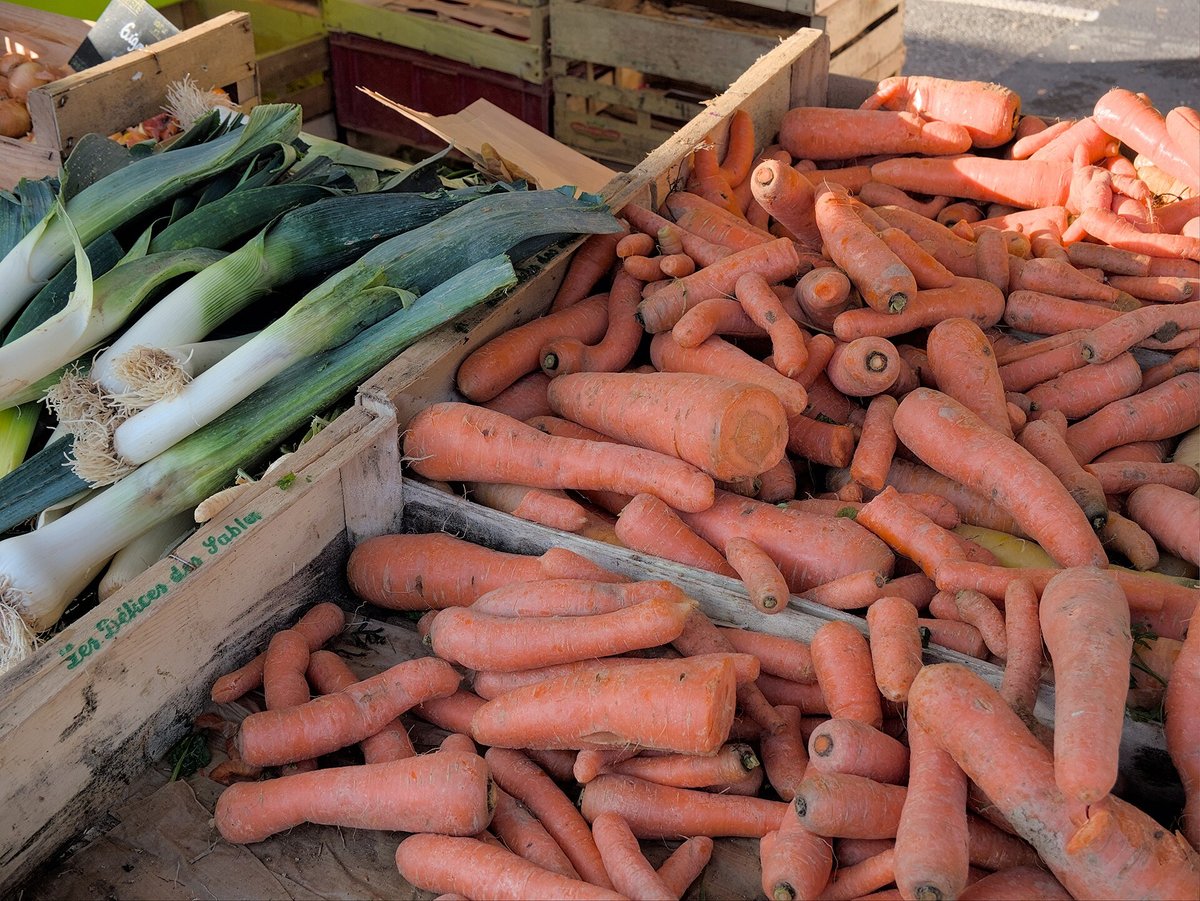
An open-air market, a Saturday morning. Two stalls.
The first displays a sign: “French origin, locally grown.” It is probably true. But beyond the sign, nothing — not a document, not a trace, no way to verify anything at all. The second sells Spanish tomatoes, and every crate lets you trace the entire chain: the greenhouse, the grower, the carrier, the temperatures recorded along the way, the date of every change of hands.
Which of the two is more transparent?
If the answer is uncomfortable, it is because we have long confused two things that have nothing to do with each other: origin and path.
A duel forty years in the making
The food debate is locked into a standoff between two positions, and each keeps the other alive.
On one side, the reflex of origin: the local as a guarantee, proximity as proof. It is an understandable reflex — we trust what we can see, who we can talk to. But a sign is a claim, not a proof. And a short supply chain can be just as opaque as a long one: one intermediary whose batches get mixed together, one delivery note re-entered from memory, and no one can retrace the path anymore — the chain is short, but broken all the same.
On the other side, the great undifferentiated market: the commodity. Wheat is wheat, a tomato is a tomato, wherever it grew. It is indifference to place raised to the level of efficiency — and it really is efficient: it is what makes volume possible, low prices, the continuous supply of cities. Its cost lies elsewhere: everything the place once contained — the soil, the practices, the distances, the hands — is ejected from the calculation, because the calculation does not need it to function.
These two positions fight each other and reinforce each other. The more the market abstracts, the harder the retreat into origin hardens; the more origin turns itself into a fortress, the more unverifiable it becomes, and the easier it is for the market to dismiss it as folklore. Forty years now that this pendulum swing has passed for a debate.
Changing the question
There is a third position, and it does not consist of splitting the difference. It consists of changing the question. Not “where does it come from” — the question of the local. Not “how much does it cost” — the question of the market. But: what path it took. The complete description of the real chain — soils, routes, temperatures, transformations, hands — however far it extends, including when it crosses three borders.
To this question, a Spanish product with an unbroken chain answers better than a village product with a broken one. This is neither protectionism nor free trade: it is the same descriptive requirement, applied equally to both. The adversary was never the import. The adversary is the unverifiable — whether it comes from far away or from next door.
Carbon, or fungibility taken to its limit
This reasoning finds its limit case in carbon — and that is where it becomes most concrete.
The carbon credit market applies to CO₂ the same gesture as the great market: make it fungible. A tonne sequestered in Brazil is worth a tonne sequestered in the Vexin; it is this equivalence that makes the exchange possible, it is what gives the market its liquidity — and it is exactly this equivalence that creates the problem. Because to make the tonne tradable, it has to be detached: from its soil, from its watershed, from what it actually does in the place where it is. A carbon credit is a tonne that has forgotten where it comes from. That is even its definition: it only circulates on that condition.
But on the ground, the equivalence is false. The same agronomic practice — a cover crop, reduced tillage, a replanted hedgerow — does not carry the same ecosystem value depending on the territory where it takes place. On degraded soil or on living soil. Inside a drinking-water catchment area or outside one. Within an ecological continuity or in an isolated patch. A tonne is not a tonne: it is worth what its place is worth.
What is needed, then, is not one more credit. It is an index: a measure that stays attached to its place, that refuses abstraction, and whose value rises precisely where the practice matters most. The difference fits in one sentence: a credit trades by forgetting where it comes from; an index only exists by holding onto it. The first rewards the tonne. The second rewards the tonne where it changes something.
“More paperwork”
The objection always arrives at the same moment, and it is legitimate: does describing more not mean adding weight? More data entry, more declarations, more inspection — the farming world already knows that burden better than anyone.
It is the opposite, on one condition. The current administrative burden is heavy because the description is poor: each actor re-enters what the previous one already knew, redeclares after the fact what no one recorded at the time, reconstructs from memory what the chain failed to retain. Paperwork is the price of forgetting, not the price of description.
The condition is to simplify the interface in order to enrich the description: that things be recorded the moment they happen, by the people who do them, in the very gesture of the work — so that no one, afterward, ever has to reconstruct them. A rich description is not the price of added friction. It is what you get once the friction disappears.
Back to the market
Let us return to the two stalls. The goal is not for the second to beat the first — that would be losing on every count, and the village grower along with it. The goal is for the first to be able, tomorrow, to answer the same question as the second: what path it took, from sowing to stall, without spending every evening on it.
On that day, origin will become again what it should always have been: an honest argument among others, verifiable like the others — not an act of faith. Proximity deserves better than a sign.
—
The opposition between attachment to place and the abstraction of the great market owes much to Bruno Latour (Down to Earth, 2017), for whom the decisive political question was neither local withdrawal nor global flight, but the capacity to describe precisely what a territory depends on to survive.
What this means for you
The same reasoning doesn't play out the same way depending on where you sit in the chain.
You're a producer
Your tonne gets paid at the price of an undifferentiated tonne. That isn’t a fact of market life — it’s the absence of an index that would price what sets it apart.
VeraTrace for producers →You process food, you're a brand
With carbon, fungibility is pushed to its limit: a credit is only worth what the verifiability of its place is worth. An index changes what a credit actually buys.
VeraTrace for processors →You're a public authority or public buyer
A policy that buys tonnes buys fungibility. What it wanted to buy was a path.
VeraTrace for local authorities →